
 Login
Login
 Stores
 Cart
Cart
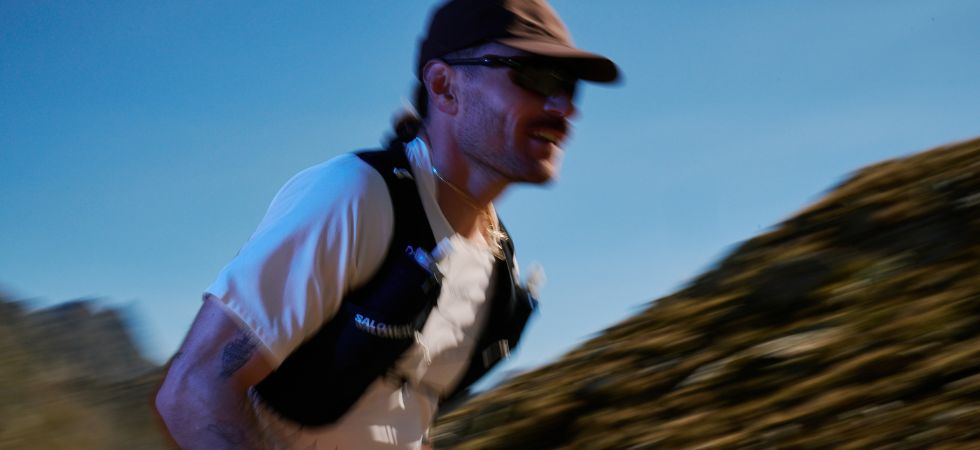
If you want to start exercising and improve your fitness, running is often the first thing that comes to mind. It gets even more exciting when you take your runs into the mountains. Congratulations, welcome to the world of trail running! But what gear do you actually need? For short trail runs, a good pair of trail running shoes and a functional outfit are often enough. As distances get longer, elevation gain increases and the terrain becomes more alpine, your equipment, safety setup and route planning become even more important. In this guide, we show you which trail running gear you really need for different distances.
After gaining your first trail running experience and putting in a few training sessions, you will probably soon feel ready to take on your first race. So why not start right on our doorstep at the Zugspitz Ultra Trail, the GaPa Trail or the GaPa Everesting Festival? Whether it is the 10 kilometre short distance at the GaPa Trail, the 16 kilometre Grainau Trail, the ambitious 160 kilometres of the ZUT 100 or the 59.4 kilometres with over 8.800 metres of elevation gain at the Everesting Festival: each distance places its own demands on your gear, nutrition and preparation. At Sport Conrad, we show you which products belong on your packing list and what to keep in mind depending on the distance and level of challenge.
Key Facts at a Glance
- 👟 Trail running shoes: Choose your shoes according to the surface, distance and terrain. Grip is key on technical trails, while cushioning and comfort become especially important over longer distances.
- 🎒 Running vest or running belt: For short trails, a compact setup is often enough. From medium distances onwards, we recommend a running vest with around 8 to 12 litres of volume.
- 💧 Hydration and energy: Plan with around 500 ml of fluid and about 60 g of carbohydrates per hour. Make sure you test your race nutrition in training beforehand.
- 🥢 Trail running poles: On routes with lots of elevation gain and over long distances, poles help take pressure off your legs and save energy.
- 🧥 Weather protection and extra clothing: The longer and more alpine the route, the more important waterproof jackets, arm warmers, leg warmers, gloves and a hat become.
Why the Right Trail Running Equipment Is So Important
Trail running places different demands on your gear than classic road running. Changing surfaces, sudden shifts in weather, elevation gain and long hours on your feet make functional and reliable equipment essential. At the same time, the rule is simple: as little as possible, but as much as necessary. On longer routes especially, every extra gram in your pack makes a difference. However, you should never compromise on safety or weather protection. How extensive your setup needs to be depends largely on distance, terrain, weather and expected running time.
Trail Running Gear for Short Runs (5 – 20 km)
For shorter trail runs, the focus is on a lightweight setup. The most important item remains your trail running shoes. They should match the surface and provide enough grip. More aggressive outsole profiles are ideal for technical trails or wet conditions, while lighter models often work well on faster forest tracks. You can find out how to choose the right shoe for you in our overview of the best trail running shoes.
For races in this distance category, you should also take the following setup:
- Lightweight running clothing based on the layering principle
- Running belt or running vest
- Soft flask with enough water, around 500 ml per hour
- Energy bars or energy gels, around 60 g of carbohydrates per hour
- Trail running first aid kit
- Smartphone and GPS watch
- Lightweight waterproof running jacket
In addition, we recommend running poles for steep climbs and a headlamp when running in the dark.
Shoes for Short Distances:


Short Distance Races in Garmisch-Partenkirchen
The Grainau Trail, with 16 kilometres and 760 metres of elevation gain, is an ideal introduction to the world of trail running races. If you want to start with something a little shorter and more moderate, the short distance of the GaPa Trail is a great option. It covers around 10 kilometres and 350 metres of elevation gain, making it perfect for gaining your first race experience on the trails. Even though these routes are considered entry level races, they will still challenge you, get your heart rate up and show you what trail running is all about. To make sure you are well prepared on the start line, it is worth planning your trail running packing list early. Event organisers often specify mandatory gear that you must carry during the race. Drawing on our own experience, we show you what to look out for and which products are especially suitable when you are getting started:
For shoes, go for closed trail running shoes with a grippy outsole suitable for alpine terrain. Beginners in particular benefit from a little more cushioning and comfort, for example with the Salomon Pulsar. A lightweight rain jacket is also part of the mandatory equipment. A waterproof rating of at least 10,000 mm is important here, so you stay reliably protected in changeable weather. A suitable choice, for example, is the Salomon Bonatti Trail.
For the short distance, a compact running vest with a small pack volume is completely sufficient. The Salomon ADV Skin 5 Set offers enough space for mandatory equipment, nutrition and fluids without weighing you down unnecessarily while running. For nutrition, we recommend two 500 ml soft flasks as well as energy gels with a total of around 120 g of carbohydrates. You will also need your own drinking cup so you can get drinks at the aid stations.
A small first aid kit is also part of your trail running gear. It should include compresses, bandage packs, disposable gloves, a triangular bandage, wound plasters, a whistle and an emergency blanket. Ready made sets from brands such as Ortovox or Deuter are a practical solution here.
For navigation, it is best to use a GPS watch with the track of your chosen route already loaded. On race day, simply following the crowd will probably be enough. But if you do end up running at the front or briefly lose your bearings, models from Garmin, Suunto or Coros will reliably guide you back on track. Good entry level options include the Garmin Forerunner 265, the Suunto Race 2 and the Coros Pace 4.
Do not forget: your mobile phone is also part of the mandatory equipment. Save the Alpine Medics emergency number before the start so you can call for help quickly if needed: +49 8324 933 550.
Not mandatory, but still useful, are trail running poles and a headlamp. Poles help you save energy and move more steadily on steeper climbs. A headlamp gives you extra safety if you are out on the course longer than expected.
Additional Gear for Short Distances:


Gear for Medium Trail Running Distances (20 – 50 km)
As the distance increases, so do the demands on your trail running gear. You need more nutrition, better weather protection and enough storage space to carry food, fluids and personal extras safely. For medium distances, your running vest can therefore have a little more volume than for short runs. We recommend around 8 to 12 litres. You should also choose a trail running shoe that is suitable for longer efforts and offers enough cushioning.
Over longer distances, it can also make sense to take in electrolytes. The key mineral here is sodium, as it is lost through sweat. As a rough guide, we recommend around 600 mg of sodium per litre of fluid. If your energy gels and bars already contain electrolytes, you can reduce the additional amount accordingly.
In addition to the equipment for short trail running distances, you should plan the following clothing for medium distances:
- Long trousers or leg warmers
- Long sleeve top or short sleeve shirt with arm warmers
- For runs at higher elevations: lightweight running gloves and a running hat
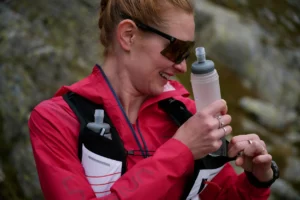
For nutrition, you can again use the following guidelines: around 500 ml of fluid and about 60 g of carbohydrates per hour. It is important not to test your race nutrition for the first time on race day. Practise taking gels, bars and drinks during training instead.
Trail running poles become increasingly useful on routes with lots of elevation gain. They take pressure off your leg muscles, especially uphill, and help you save energy over longer periods. On descents, they are usually folded away and attached to your running vest or stored directly in a suitable pole quiver.
Trail Running Shoes for Medium Distances:


Mid Distance Races in Garmisch-Partenkirchen
The Garmisch-Partenkirchen Trail, with 29 kilometres and 1,565 metres of elevation gain, and the Mittenwald Trail, with 44 kilometres and 2,110 metres of elevation gain, are the next longer distances at the Zugspitz Ultra Trail. At the GaPa Trail, the medium distance of around 20 kilometres with approximately 850 metres of elevation gain and the long distance of around 26 kilometres with around 1,050 metres of elevation gain offer further exciting options.
The basic gear is almost identical, with the main addition being warm and flexible clothing. For the ZUT distances, for example, long trousers or leg sleeves are mandatory, as well as a long sleeve top or a short sleeve shirt with arm sleeves. The key rule is that no skin may be visible. Your head and ears must also be covered, for example with a hat or neck tube. Gloves are also part of the mandatory gear for these distances.
We recommend using arm and leg warmers because they weigh very little, take up hardly any space and can be put on or taken off quickly while on the move. At the same time, they help you meet the basic rule that no skin should be visible when required.
Arm and Leg Warmers:


Trail Running Gear for Ultratrails (50+ km)
On ultratrails, gear becomes a decisive factor. Long running times, changing weather, night sections and alpine conditions require a much more extensive packing list. Alongside reliable shoes and a larger running vest, your basic setup should include:
- A generous amount of nutrition, including solid food, based on around 500 ml of fluid and 60 g of carbohydrates per hour
- Electrolytes, around 600 mg of sodium per litre of fluid
- Headlamp with at least 800 lumens
- Power bank, as your phone, sports watch and headlamp may need extra charge on very long distances
- Trail running poles
Before a race, all of your equipment should already have been tested thoroughly in training. Pressure points, a poorly fitting running vest or unfamiliar nutrition can quickly become a problem over many hours on the trail.
Shoes for Ultra Distances:


Long Distance Races in Garmisch-Partenkirchen
For experienced trail runners and ambitious ultra runners, some of the region’s most challenging routes await around Garmisch-Partenkirchen. The Leutasch Trail (69 km, 3140 m+), the Ehrwald Trail (86 km, 4295 m+), the Ultratrail (107 km, 5280 m+) and the ZUT 100 (166 km, 8205 m+) are the long and ultra distances at the Zugspitz Ultra Trail. The GaPa Everesting Festival, with a total of 59,4 km and 8.848 metres of elevation gain, is also a serious challenge.
Ultra distances are where trail running becomes a true endurance challenge. You are out for significantly longer, switch more often between climbs, descents and flatter sections, and need to be prepared for darkness, sudden weather changes and longer gaps between aid stations. This makes your packing list even more important.
Compared to the shorter distances, you need more fluid capacity. Instead of at least 1 litre, closable water bottles or soft flasks with a total capacity of at least 1.5 litres are part of the mandatory equipment. A headlamp also becomes especially important on these distances. We recommend a lamp with at least 800 lumens, a secure fit and the lowest possible weight. Also make sure the battery life is sufficient for your planned time running in the dark. For the ZUT 100, two fully functioning headlamps with spare batteries or spare rechargeable batteries are mandatory.
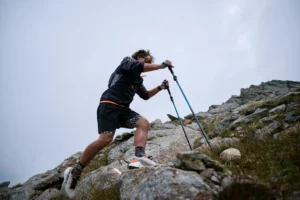
Trail running poles can make a big difference over long distances. They take pressure off your leg muscles uphill, help you on long climbs and make it easier to find a steady rhythm. It is important that you use the poles in training beforehand and practise folding and unfolding them quickly. We recommend lightweight folding poles that can be attached compactly to your running vest whenever you do not need them.
Trail Running Poles:


Headlamps:


Conclusion: The Right Gear for Every Distance
Whether you are taking on a short entry level trail, a medium distance or an ultratrail, the right trail running gear helps you move more safely, comfortably and confidently. For short distances, the focus is on compact mandatory equipment, enough fluids and the right shoes. For medium and long distances, weather protection, extra clothing, nutrition, a headlamp and running poles become increasingly important.
Most importantly, do not test your gear for the first time on race day. Break in your shoes, try your running vest with a full load and practise your nutrition during longer training sessions. That way, you know what works, what fits well and what you can rely on during the race.
To help you keep track of your preparation, we have summarised the most important points for you. Download our Trail Running Packing List as a PDF here. And if you have any questions, you can always visit us in our stores in Garmisch Partenkirchen, Penzberg or Wielenbach for personal advice.