
 Login
Login Stores
 Cart
Cart


"We inspire, move and connect people who are crazy about the mountains. And: we rethink."
As a fourth-generation family business rooted in the Bavarian Alps, we carry responsibility— for people, for nature, and for future generations. That’s why we developed our sustainability strategy “Wir denken um” (We Rethink). Our goal: To become the most sustainable outdoor retailer in the Alpine region, offering Alpine products.
"I spend a lot of time in the mountains myself, and I hope my children will be able to do the same. That’s my personal motivation. I don’t want to leave any stone unturned, because this issue is far more important than many of the things that occupy us in daily life. We all know: we can’t keep doing business the way we have. And I’m determined to change that."
Hans Conrad, Managing Director of Sport Conrad

Back in 2018, we set an important course with the launch of our sustainability initiative. We asked ourselves: How can we, as a fourth-generation family business, operate in a way that remains viable for generations to come?
The result was a comprehensive sustainability strategy that runs throughout the entire company — from how we label our products to the values and knowledge we pass on to our trainees.
"'Wir denken um (We Rethink) is more than just a project for us. It’s a mindset that shapes our daily actions — from purchasing and logistics to our product range. We want to prove that responsible business practices in the sports retail industry are not only possible, but essential.”
Maira Ries, Head of CSR at Sport Conrad

"The most sustainable outdoor retailer in the Alpine region with Alpine products."
That’s the goal we’ve set for ourselves.
But future-oriented action is not a solo sprint—it’s more like crossing the Alps. And we don’t do it alone, but as a team: the Sport Conrad team. Together with our suppliers, our customers, and even our competitors. Because without cross-organizational cooperation, real progress is impossible.
It is on this foundation that we developed our Sport Conrad Roadmap 2030. It outlines our goals and concrete actions through the year 2030—and it shows both what we’ve already accomplished along the way, and what still lies ahead.
>>> OUR ROADMAP

Our sustainability strategy in four fields of action
As a family-owned company, we are committed to responsible business practices and forward-looking action. That’s why, in 2018, we introduced our “Wir Denken Um” (We Rethink) strategy for the first time—built around four key areas of action, forming the foundation of our “House of Sport Conrad.” With this approach, we aim to shape the future together. Together with the Sport Conrad team, our partners, and our suppliers, we want to lead by example—and inspire others to join us on this journey.


Our carbon footprint in the context of sustainability
In order to drive change, we first need to understand where we currently stand. That’s why we assess our status quo each year by calculating our carbon footprint. This assessment forms the foundation for defining reduction targets and measures, helping us to systematically lower our CO₂ emissions over time.
With our label WIR DENKEN UM, we want to make sustainability visible—both in our stores and in our online shop. We highlight brands that operate in a responsible, socially fair, and environmentally sustainable way.
Our WDU product labeling is designed to help you make informed and conscious purchasing decisions. To ensure this, we’ve introduced a two-step evaluation process and regularly review both our suppliers and their products.
> > > More about our 'Wir denken um' Label

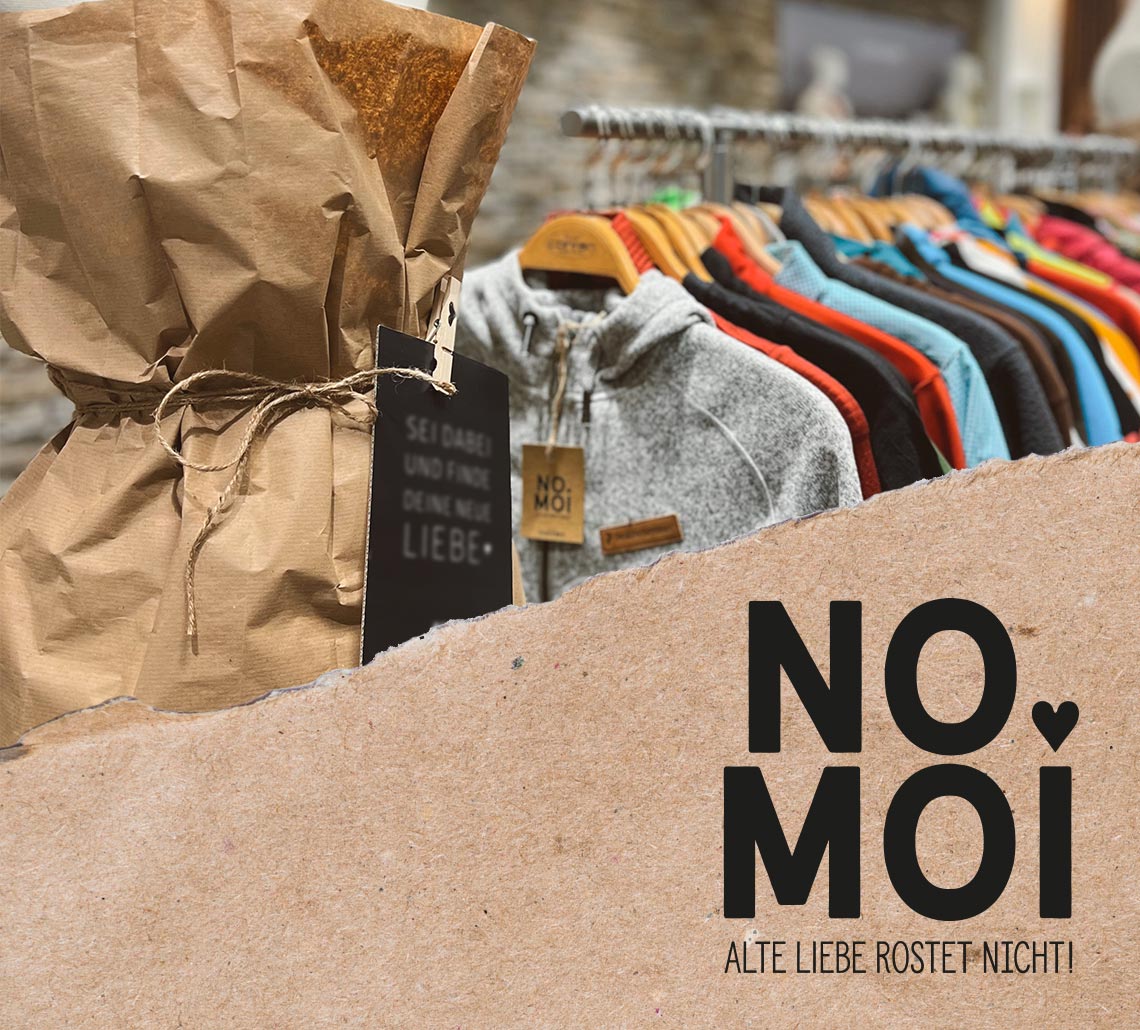
Using our planet’s resources responsibly is important to us. That’s why we created Nomoi—our secondhand program for pre-owned outdoor clothing for both kids and adults.
Nomoi – [nomåi] (adv.), Bavarian: “once again,” “a second time” – is our contribution to conserving resources:
> Better for the environment & climate: By buying and selling secondhand, we extend the life cycle of high-quality outdoor clothing.
> Quality-checked: We only accept clean and fully functional items.
> Community-based: Everyone benefits—buyers get premium gear at fair prices, sellers receive a Sport Conrad voucher, and together we reduce our environmental impact.
Give your well-preserved but unused garments a second life—or discover great-quality pre-loved items at fair prices in our stores.
>>> more about Nomoi
As a traditional family business in its fourth generation, supporting non-profit associations and projects has always been close to our hearts.
Our donations support organizations committed to nature and climate protection, mountain rescue, medical care, child and youth development, social causes, sports, and culture.
To contribute, we organize various initiatives every year—for example, reforestation of protective forests, ski ticket donations for children, or fundraising through our internal "Rekla" sale benefiting the Himalaya's Children Foundation.
>>> our Engagement

Wir denken um: are you joining us?
We believe that shaping the future can and should be fun. That's why we always want to create moments where we actively come together as the Sport Conrad community. Whether at community events, clean-up campaigns, tree-planting events or our Nomoi second-hand programme: Sustainability thrives on participation and together we can achieve more.
Are you in?


Sustainability meets outdoor sports - Find out more at Sport Conrad


FAQ
Which outdoor brand is sustainable?
There are several outdoor brands that are clearly committed to sustainability. Examples include Patagonia, Vaude, Ortovox and Houdini. These companies focus on environmentally friendly materials such as recycled polyester, fair production conditions and transparency in the supply chain. Many are also certified according to standards such as bluesign®, GOTS or Fair Wear Foundation. A truly sustainable approach is not only reflected in the material, but also in the entire corporate culture.
Why is sustainability so important in outdoor sports?
Anyone who is out and about wants to experience unspoilt nature and that is exactly what needs to be protected. However, outdoor sports also bring challenges with them: synthetic materials, long transport routes and sometimes short product life cycles. Sustainability helps to reduce these effects, for example through durable equipment, recycled fabrics or environmentally friendly production. Sustainable outdoor sport means taking responsibility for your own actions in nature and along the supply chain.
What can I do as a customer to improve sustainability?
As a customer, you can make an important contribution to greater sustainability - often with very simple decisions. Buy consciously instead of buying a lot and opt for quality that lasts. Good care and minor repairs can significantly extend the service life of your equipment. When buying, look out for reliable sustainability labels such as bluesign®, Fair Wear or GOTS, and avoid unnecessary returns by getting good advice in advance or trying on products on site. Repair services or second-hand offers are also sustainable alternatives to buying new. And last but not least: your demand determines the supply; buying sustainably strengthens brands that take responsibility.
What does sustainability mean for outdoor equipment?
Sustainability means here: Products that are produced in an environmentally friendly manner, manufactured in a socially responsible way and are particularly durable. This includes recycled or natural materials, fair production and reparability. Packaging, transport and the possibility of return or recycling also play a role. In short: sustainable equipment has as little impact on the environment as possible - while maximising functionality.
How can I save CO₂ when buying equipment?
You can significantly reduce CO₂ emissions by buying durable outdoor products that will last for many years and choosing equipment that can be repaired rather than quickly replaced. Using recycled materials also helps to reduce emissions. When shopping, pay attention to regional suppliers or use climate-neutral shipping options in online retail. Second-hand offers or hire systems are also sensible alternatives to buying new. Last but not least, it helps to critically scrutinise your own needs: do you really need something new or is what you already own enough?



.png)