
 Login
Login
 Stores
 Cart
Cart
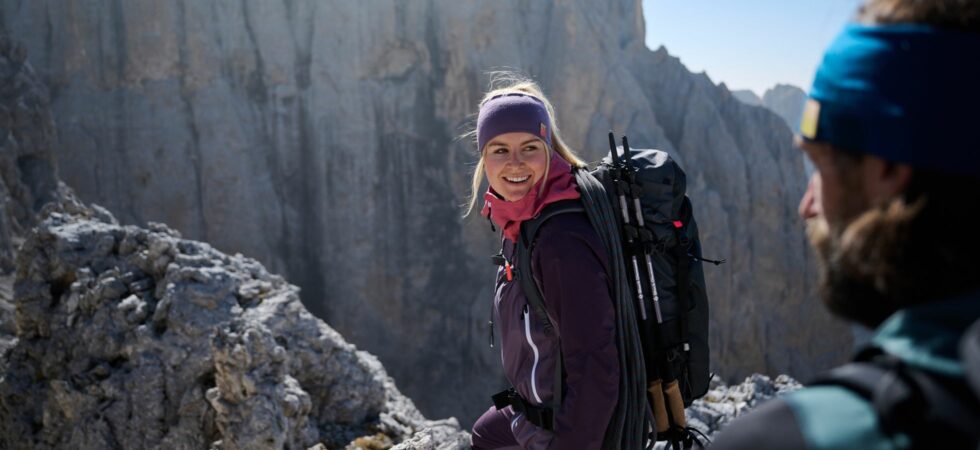
Lena Koller from Tyrol is currently training to become a mountain guide in Austria. We talked to her about her experiences in a male-dominated field and her love for the mountains.
Conrad Magazine: Why did you decide to become a mountain guide?
Lena Koller: First of all, I love the mountains. As a mountain bike coach, I have already experienced how exciting working with people and groups in such a setting can be. It is definitely not an easy task. But being able to share the joy with motivated people who may have surpassed themselves or gained a special mountain experience definitely makes up for everything.
What does the training involve?
First, you have to pass the entrance exams in winter and summer and have your tour book complete. Then you move on to the course blocks, which take the candidates through three and a half years of training until the final exam in Chamonix. Attendance is mandatory for every course, there are ongoing assessments throughout the week, and there are final exams. From an athletic perspective, the courses cover rock climbing (sport and alpine climbing), skiing on the slopes and freeriding, ski touring and avalanche awareness, ski and summer mountaineering, and ice climbing. In addition, the main topics covered in each part of the course include tour planning, rope and safety techniques, orientation, weather, snow and avalanche awareness, emergency management, and much more.
How many mountain guides are there in Austria, and how many of them are women?
There are currently around 1,500 mountain guides in Austria, just under 30 of whom are women. There are 35 participants in my year, two of whom are women.
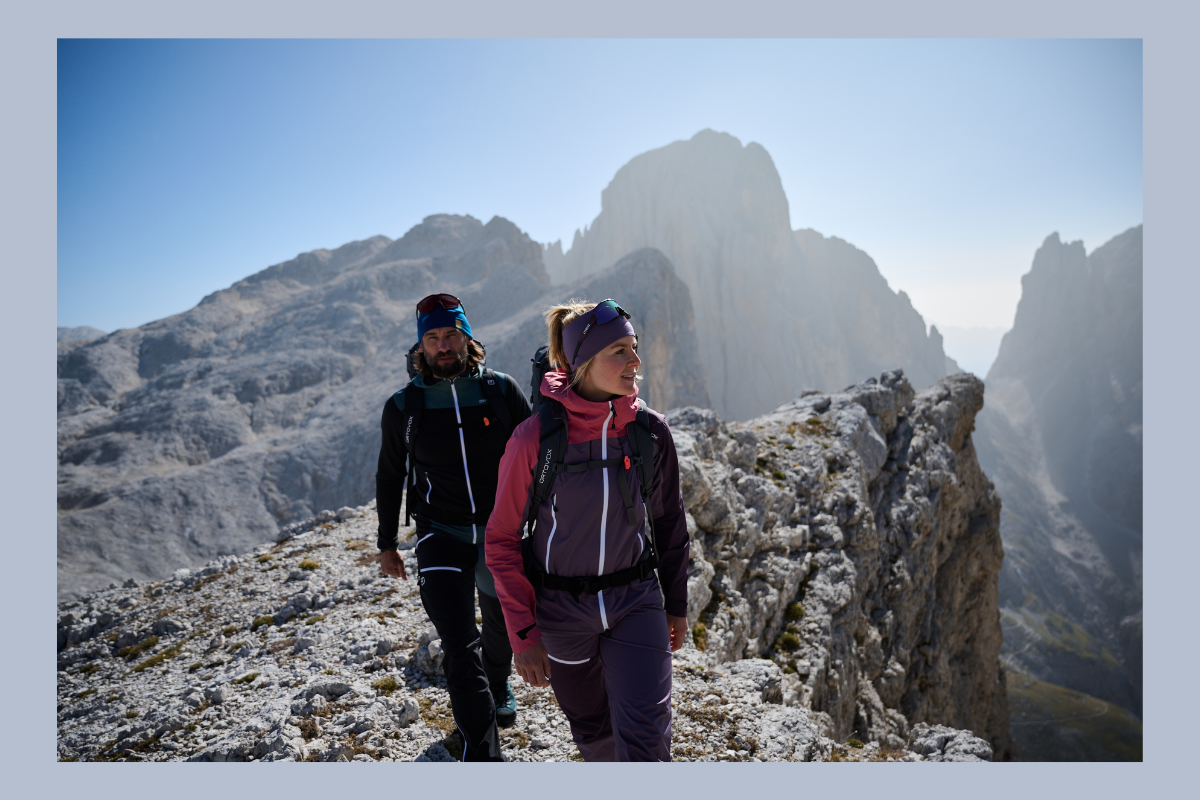
Lena Koller is one of the few female mountain guide candidates and is certain that more female role models are needed in the mountains. Photo: Sport Conrad
Do you think women fulfill the role differently than men?
Basically, I believe that everyone would benefit equally if there were a balanced gender distribution in the profession. In my opinion, there are certain character traits that tend to be more common in women or men and can be advantageous for the mountain guide profession. For women, I think of patience or empathy, for example, and for men, self-confidence or determination. We can learn from each other in many areas. I think that every mountain guide performs the role differently to a certain extent. However, I don’t think that this necessarily depends on gender. Perhaps it depends more on the expectations that clients, colleagues, or society have of a mountain guide. I can’t speak from my own experience yet, so I’m very excited to see how I can fill the role myself and hope to live up to my own expectations.
Why is it good for more women to discover this profession for themselves?
There are simply far too few female role models in mountaineering. I believe that when women see other women in leadership roles, making decisions and taking responsibility, leading the way or climbing as part of a women’s rope team, their belief in their own abilities grows. Being able to climb independently in the mountains is extremely good for self-efficacy – it strengthens your confidence in your ability to cope with difficult situations. At the same time, it is safer, because you learn to recognize dangers better. Being independently responsible for yourself in the mountains is extremely good for self-efficacy—it strengthens your confidence in your ability to cope with difficult situations. At the same time, it’s safer because you learn to assess dangers better. And above all, it’s just fun! That’s why there should be more female mountain guides and thus more female role models in the mountains.
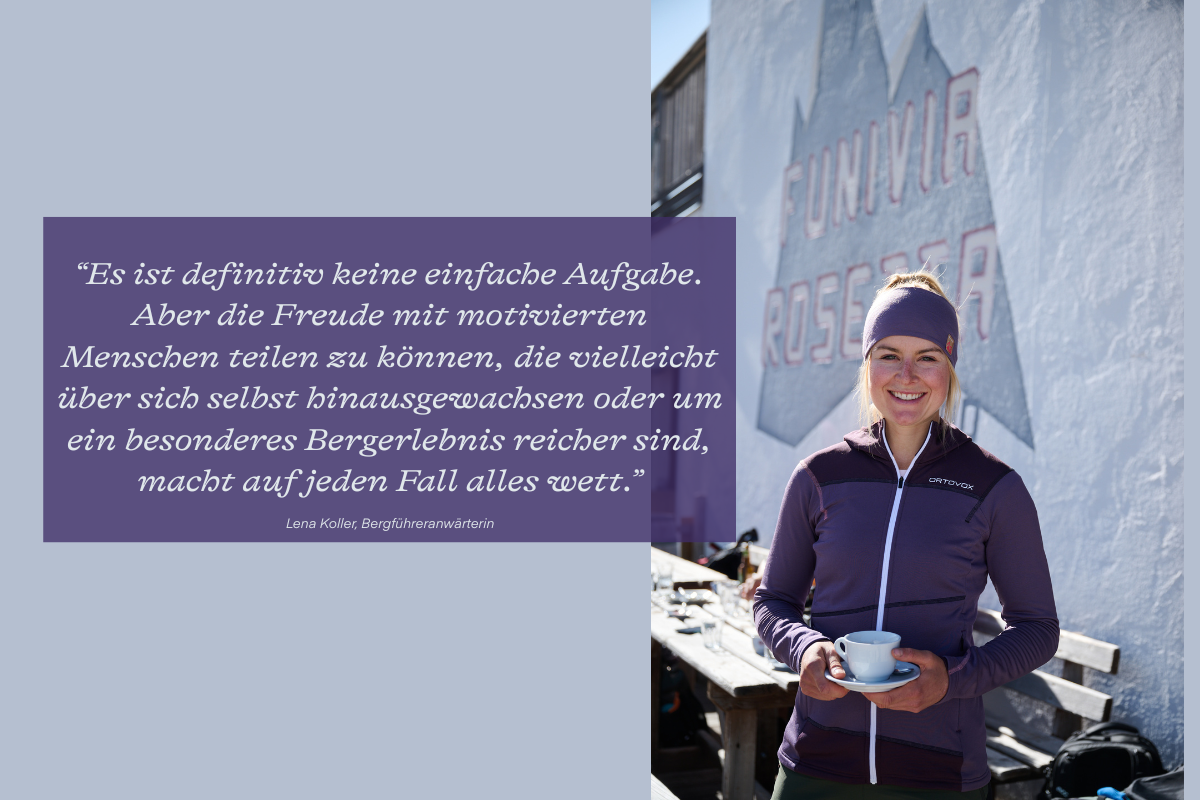
Self-esteem cannot be measured by performance, as Lena Koller learned from her mountain guide training, among other things. Photo: Sport Conrad
Has your training changed your view of the mountains and nature?
I am more aware of the dangers. I used to be more naive and carefree. At the same time, it’s a good feeling to have more and more tools at my disposal for dealing with unpredictable situations. Of course, I’m also more aware of how we as humans are damaging nature. This becomes even more apparent in high mountains or on glaciers. Climate change is rapidly increasing the objective dangers there, which is of course an additional risk for mountain guides.
What did you learn about yourself during your mountain guide training?
That it’s important for me not to measure my self-worth by my achievements, and that I don’t want to judge others by their abilities either. I’m realizing more and more how important personal development and learning are to me. I hope I never lose the motivation to hone my hard and soft skills.
And what about other people?
Everyone is afraid of failure, and that’s not easy for anyone; we’re all in the same boat. And exams, of which there are many in mountain guide training, inevitably involve the possibility of failure. However, rebuilding your self-confidence after a minor or major setback enriches your personality and strengthens your resilience.
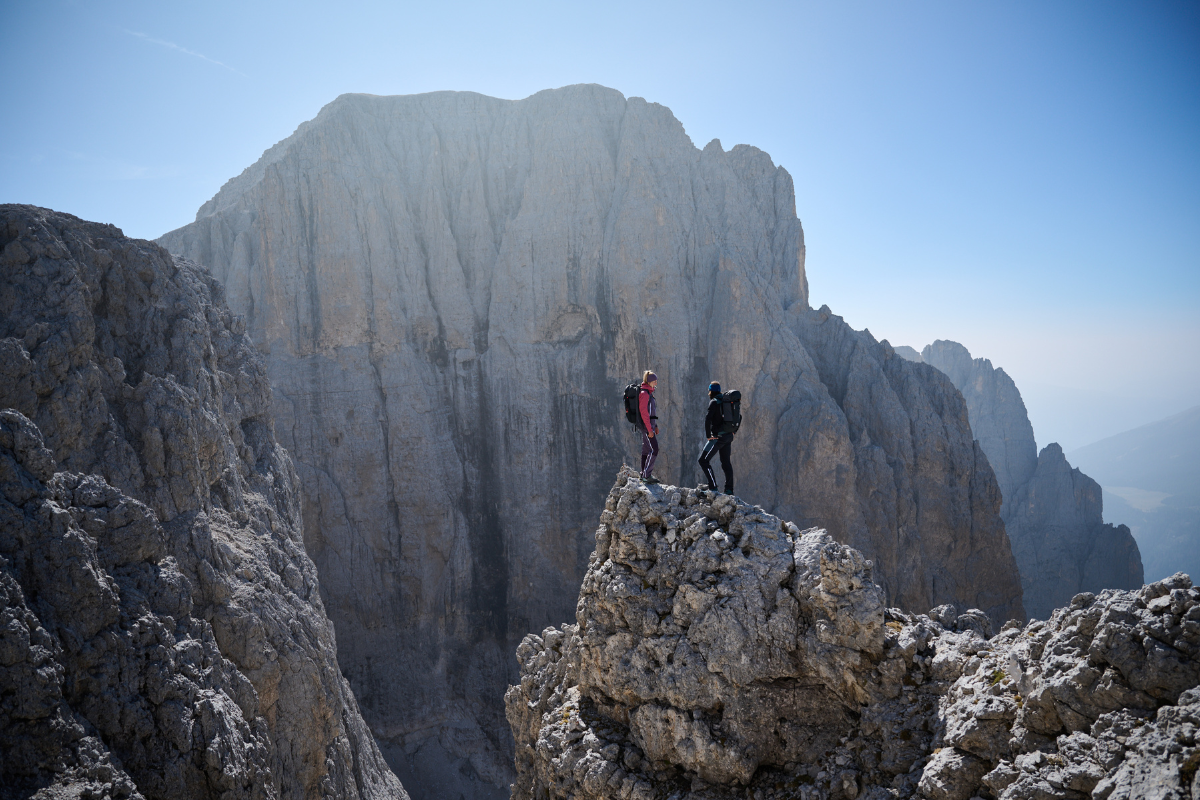
“Just accept challenges and dare to try something new,” emphasizes Lena Koller in an interview. Photo: Sport Conrad
And what about life in general?
That it’s worth investing a lot of energy in a big personal goal. And just accepting challenges and daring to try something new—even if it seems far too difficult or perhaps impossible at first.
Do you have any tour recommendations in your home region?
In summer, I really enjoy climbing in Schüsselkar or Wilder Kaiser. I often went hiking in “Koasa” as a child, so it all feels very familiar. In winter, the Kalkkögel mountains fascinate me every season with their rugged peaks and gullies – a ski tour there has never disappointed me. It’s not called the “Little Dolomites” for nothing.
You may also be interested in:
- The Headlamp Guide – The Best Headlamp for Your Needs
- How to layer your look with Ortovox
- Nature-friendly hiking – 7 tips for travelling