
 Login
Login
 Stores
 Cart
Cart
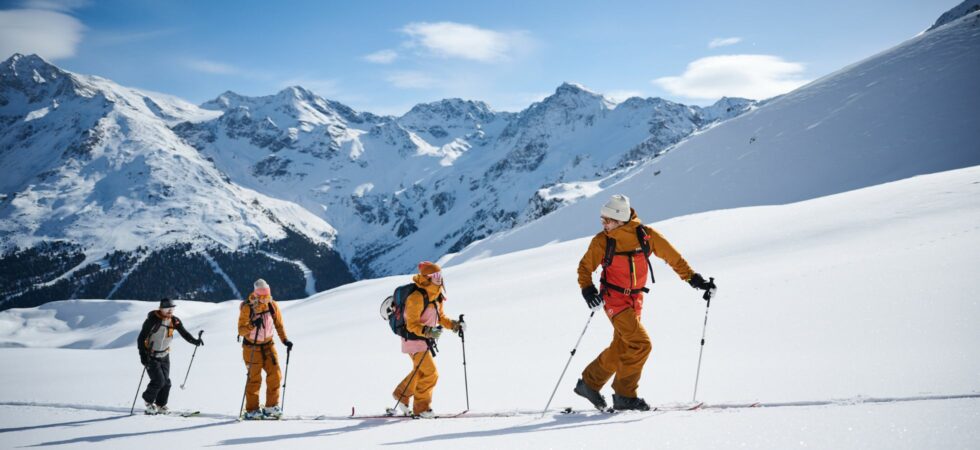
Balancing Weather and Temperature Fluctuations and Being Prepared for Anything? That’s possible with the layering principle. Here’s how it works!
Anyone who has ever peeled an onion knows: an onion consists of multiple layers, one on top of the other. That’s exactly the idea behind dressing according to the “onion principle”—multiple layers help prevent you from getting too cold or sweating too much, while allowing you to adapt quickly to changing conditions.
This is especially important for outdoor sports. Instead of wearing a single thick layer, you typically wear multiple thin ones. Using selected Ortovox products as examples, we’ll show you how to dress optimally for ski touring, alpine climbing, and freeriding—and what to keep in mind.
The three layers of the “onion principle”
Roughly speaking, the layering principle consists of three layers. However, this shouldn’t be seen as a rigid rule but rather as a general guideline. For example, if it’s extremely cold, adding an extra insulation layer can be beneficial. On the other hand, if it’s warmer, you might choose to skip the middle layer entirely. It all depends on external conditions—as well as how quickly and strongly you sweat or feel cold.
Layer 1: The Baselayer for Breathability
The baselayer is the innermost layer of your clothing. This includes undershirts, underwear, socks, as well as T-shirts or long underwear—all worn directly against your skin. This layer plays a crucial role: keeping you warm in the cold and cooling you down in the heat.
The key here is good breathability. Your baselayer should wick sweat away from your skin to keep you dry. Cotton is not ideal since it absorbs moisture and stays wet for a long time. Instead, we recommend clothing with wool content. For optimal performance, your baselayer should fit snugly and without wrinkles.
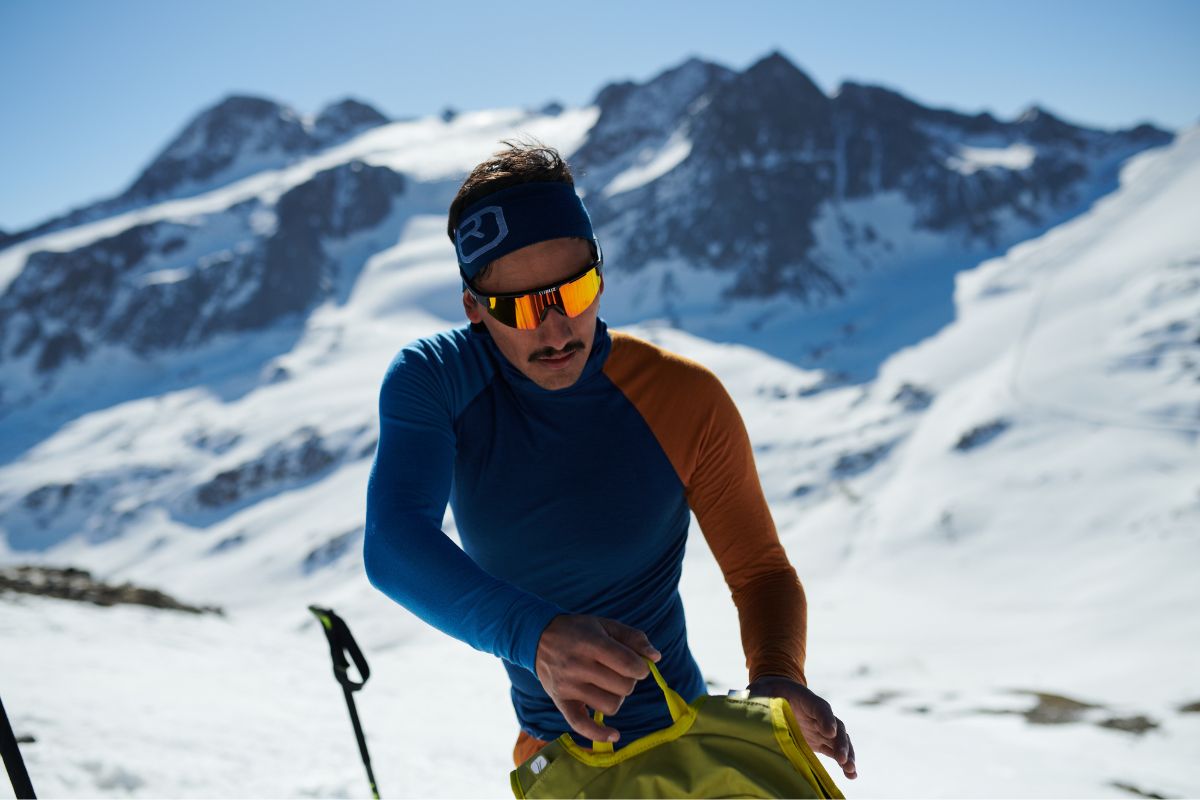
The bottom layer of clothing stands for one thing: breathability. Photo: Sport Conrad
Layer 2: The Midlayer for Insulation and Warmth
Over your baselayer, you wear the midlayer, which is primarily responsible for warmth and insulation. If it’s extremely cold, you can even combine multiple midlayers.
This layer can include sweatshirts, vests, fleece jackets, long-sleeve jerseys, or for the legs, wool pants or short insulated pants over a thinner base layer. In very low temperatures, your midlayer might even be an insulated jacket for extra warmth.
A key feature of your midlayer is breathability—it should allow moisture to escape so you don’t get cold from trapped sweat.
Water-repellent and wind-resistant midlayers can be especially practical, as they can also serve as an outermost layer during an ascent. Like the baselayer, this layer should fit snugly but comfortably.
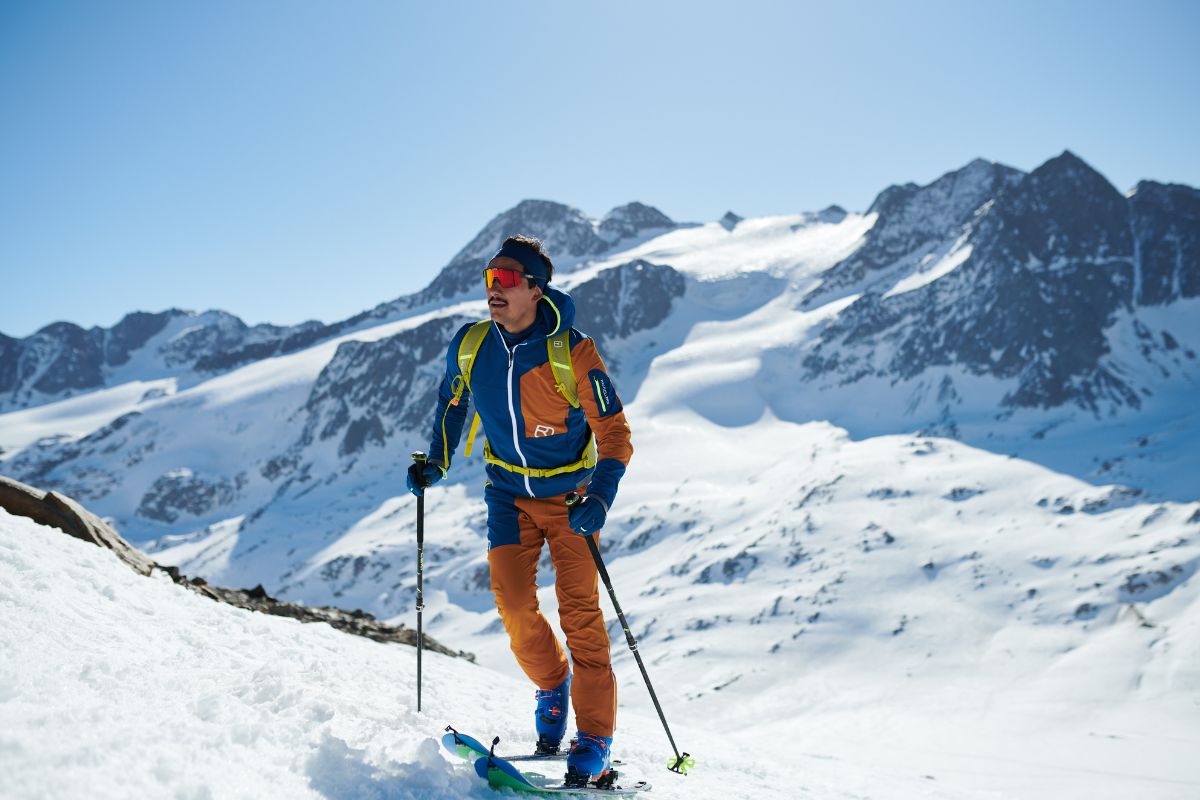
By nice weather, a softshell jacket is enough as a top layer, but protection from the wind is important. Photo: Sport Conrad
Layer 3: The Toplayer for Protection Against Moisture and Wind
The top layer of clothing is the top layer or outer shell. The main purpose of this layer is to protect you from direct weather influences, i.e. wind, rain, snow and cold. The top layer helps to prevent you from cooling down. Top layers include jackets and trousers.
A top layer usually has an integrated membrane. In the case of jackets, this can be a hard shell jacket that is completely windproof and waterproof, and in the case of trousers, waterproof ski trousers or alpine touring trousers – but also insulating shorts over softshell trousers. Always remember: although hardshell jackets and trousers are also breathable, the more waterproof they are, the less moisture can escape.
For the top layer in particular, it is therefore important to consider what kind of weather you will be out in: If it doesn’t rain much, a softshell jacket may be the better choice. It keeps out wind and light rain and is recommended in cool, dry to slightly damp conditions. If you pay attention to good breathability here, you can also use it on strenuous ascents.
If the weather is crisp, cold and dry, an insulating jacket is perfect as a top layer. It keeps you warm and usually also protects you from the wind – but it’s not ideal in the rain.
If the temperatures are warmer, you can also wear the top layer as a second layer, directly over the base layer. As I said, try it out to see how it feels best for you.
Out and about with Ortovox: The Layering Principle in Action
To make things more practical, we’ve teamed up with Ortovox to give you some useful tips for your next adventure—whether it’s ski touring, alpine climbing, or freeriding. Here’s how the layering principle applies in different scenarios.
Layering for Ski Touring
When ski touring, it’s essential to manage sweat while climbing, yet still stay protected from cold, wind, and moisture. On the descent, you need protection from windchill and wet conditions.
For women:
For men:
Layering for Alpine Tours
An alpine tour is similar to a ski tour – while ascending, you should be protected from harsh conditions, but you’ll likely get warm, so you shouldn’t wear too many layers. Once you’re on the summit and want to enjoy your snack, you’ll probably need a warm jacket.
For women:

For men:


The Layering Principle for Freeriding with Ortovox Products
If you’re freeriding with lift support, you typically don’t have long ascents ahead of you and start your day directly in the powder. However, even then, you’ll sweat during the descent, and sitting on the lift can be uncomfortable if you cool down too much.
For women:
For men:
MORE TIPS ON HOW TO DRESS PROPERLY FOR YOUR OUTDOOR SPORTS:
-
- If you’re already comfortably warm when you start moving, you’re dressed too warm. You should shiver a little when you start, because you will certainly get warm quickly when you move.
- Quality instead of quantity – you’d rather have fewer pieces of good quality in your wardrobe than many pieces that don’t have good functionality.
- Breathability is the key.
- Rather wear several thin layers than a thick one, then you are more flexible.
- Try different combinations every now and then until you have found your perfect layers for any weather.
- Always have an emergency jacket in your backpack for long mountain tours. Here, for example, a down jacket with a small pack size is suitable.
- The layering also works for head and hands: for example, light beanie plus hood, thin finger gloves with mittens.