
 Login
Login
 Stores
 Cart
Cart
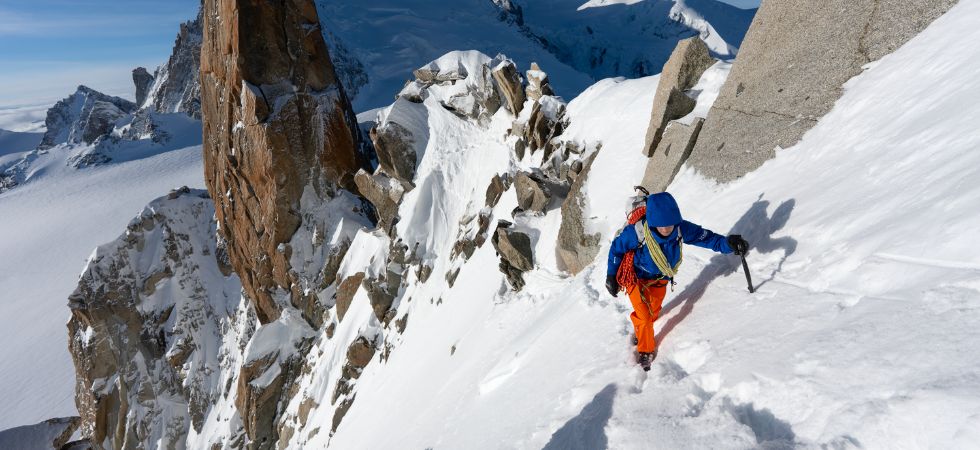
A high alpine tour places different demands on your gear than a classic mountain hike. As soon as glaciers are involved, rope, harness and crevasse rescue equipment become part of your tour planning. Firn and old snow fields can also be tricky. Here, gradient, snow hardness, fall terrain and time of day determine which gear and techniques are required. To make packing easier, you’ll find a complete overview of essential mountaineering equipment here, along with a practical packing list to print out.
Mountaineering packing list download
Check your gear before the tour and see what you really need for a high alpine tour.
Alpine Mountaineering Packing List
What your gear needs to do on a high alpine tour
The biggest difference compared to a simple mountain hike lies in the demands of the terrain. On classic high alpine tours, you often move through alpine environments, frequently across glaciers, firn, old snow, boulder fields or exposed ridges. Many routes lead to elevations around or above 3,000 metres. But it is not just altitude that matters. Weather, objective hazards, technical sections and the necessary rope and safety techniques are just as important. That is why you need gear you can rely on in challenging conditions, including crampon-compatible boots, an ice axe and a rope with the right safety equipment. This gear is not a nice-to-have. It is the foundation that allows you and your rope team to react properly in an emergency.
Then there is the altitude itself. Between 3,000 and 4,000 metres, temperatures fluctuate much more than they do in the valley, UV radiation is far more intense due to snow and ice, and many tours start well before sunrise. Your clothing therefore needs to cover a wide range of temperatures, your backpack needs to be compact enough for climbing sections, and essentials such as a headlamp and sun protection belong in your pack from the start.
📌 Because a high alpine tour requires alpine experience as well as training in rope techniques and crevasse rescue, beginners should first join a guided tour.
Your high alpine tour gear
- 🧥 Clothin
- 🥾 Mountaineering boots
- 🎒 Backpack
- 🧗 Mountaineering equipment
- 🧭 Navigation &
- First aid & emergency equipment
- ☀️ Sun protection
- 🥪 Food & practical accessories
- 🛖 Additional gear for hut stays
Clothing
On a high alpine tour, conditions can change dramatically within just a few hours. It may be warm and summery in the valley, but icy cold on the summit. The layering principle is therefore an essential part of your kit. A good setup includes a functional base layer made from merino or synthetic fibres, an insulating midlayer, a lightweight insulation jacket for breaks and windy sections, and a hardshell jacket to protect you from wind, snow and rain. When walking with crampons, robust, full-length touring pants with a close fit are also important so you do not catch the spikes on the fabric.
- Functional underwear, merino or synthetic
- Long sleeve shirt and short sleeve technical shirt
- Fleece or softshell jacket as a midlayer
- Lightweight down or synthetic jacket as an insulation layer
- Waterproof and windproof hardshell jacket
- Durable touring pants with reinforced inner leg panels
- Waterproof and windproof overpants
- Warm hat, neck warmer, and both thin and insulated gloves
- Cap for sunny sections
- Spare socks and spare underwear


Mountaineering boots
Your boots play a key role in how safely you move over rock, firn and ice. For easier high alpine tours, you need at least semi-crampon-compatible mountaineering boots, often in category B/C or C. The category is important, but so is compatibility with your crampons. Strap-on bindings work with many semi-crampon-compatible boots, while semi-automatic crampons usually require a heel welt. Fully automatic crampons are reserved for more specific use cases and require suitable welts at both the heel and toe.
- Category B/C or C mountaineering boots, semi-crampon-compatible or crampon-compatible
- Suitable insoles
- Gaiters, depending on snow conditions
- Spare laces


Backpack
On a high alpine tour, you carry all your safety equipment, clothing and food, plus spare clothing and a hut sleeping bag liner. For many guided or hut-based high alpine tours, a backpack with a volume of 25 to 35 litres is usually sufficient. Depending on the duration, weather, personal gear and how rope and safety equipment are distributed within the group, a little more volume can also be useful. Make sure your backpack has attachment options for an ice axe and helmet on the outside.
- Touring backpack, approx. 25 to 35 litres
- Rain cover, unless the backpack is already waterproof
- Stuff sacks for organising the inside of your backpack


Mountaineering equipment on the glacier
As soon as your route crosses glaciated terrain, a mountain tour becomes a technical undertaking. Crampons, an ice axe, harness and helmet form the basis. Added to this is the safety equipment for the rope team: carabiners, accessory cords and slings. Depending on the route, conditions and safety concept, ice screws may be useful or even necessary. The rope team should decide in advance exactly what to bring, taking into account the tour, current conditions and everyone’s level of training. This equipment is only useful if you have learned how to use it properly beforehand. Solid training is therefore just as important as the gear itself.
- Crampons with bindings that fit your mountaineering boots exactly
- Ice axe
- Climbing harness or mountaineering harness
- Climbing helmet
- Climbing rope
- Slings and accessory cords
- HMS carabiners and standard carabiners
- Ascender and progress capture pulley
- Ice screws
- Trekking poles
Navigation & technology
Classic trail markings are often missing on glaciers. Tracks can change quickly due to weather, fresh snow or melting snow cover. A topographic map, compass and altimeter as analogue navigation back-ups therefore belong in your pack, along with digital tools such as a GPS device or a sports watch with altimeter, compass and GPS functions.
- Topographic map or guidebook
- Compass
- Altimeter
- GPS device
- Sports watch
- Headlamp, as many high alpine tours start before sunrise
- Fully charged mobile phone with saved emergency number
- Spare batteries and charger or power bank
First aid & emergency equipment
In high alpine terrain, it often takes much longer for help to arrive than in lower mountain ranges. A well-equipped first aid kit and dressing materials are therefore part of the basic kit, just like a bivy bag that protects against wind and cold in an emergency. It also makes sense to pack painkillers and blister plasters.
- First aid kit
- Bivy bag
- Emergency blanket
- Painkillers
- Blister plasters
- Cable ties
- Tape


Sun protection
At high altitude, UV radiation is much stronger than in the valley. Snow and ice also reflect the sunlight. Glacier glasses with side protection shield your eyes from this double exposure, while sunscreen and lip balm with a high sun protection factor help protect your skin and lips from sunburn. A cap or hat adds extra protection for your head and face on sunny days.
- Glacier glasses or high-quality sunglasses with side protection, ideally category 4, at least category 3 depending on the intended use
- Sunscreen, SPF 50
- Lip balm with UV protection
Food & practical accessories
On a high alpine tour, altitude, cold and physical effort mean you use more energy and fluids than on a comparable hike in the valley. It is best to split your drinks across several containers: a hydration bladder so you can drink while moving without stopping, plus one or two shatterproof water bottles for breaks. In cold conditions, the drinking tube should be insulated. When it comes to snacks, you should already know before the tour what you like and what your stomach tolerates well. Pack small snacks so they are easy to reach, for example in hip belt pockets or jacket pockets. Cash for the hut, a pocket knife or multitool and a trash bag for your own waste complete the basic kit.
- Hydration bladder and/or shatterproof water bottle
- Food, such as energy bars, dried fruit or packed snacks, depending on the length of the tour
- Pocket knife or multitool
- Cash
- Trash bag
- Seat pad
Additional gear for hut stays
Many classic high alpine tours are planned as two-day or multi-day trips with an overnight stay in a mountain hut. For this, you need a few extra items. A hut sleeping bag liner is mandatory in many huts, and you will also need wash kit, a small towel and your Alpine Club membership card for the member discount.
- Hut sleeping bag liner
- Small towel and wash kit in a toiletry bag
- Hut slippers
- Alpine Club or Friends of Nature membership card
- Earplugs
Conclusion: The right gear for your first high alpine tour
With the right mountaineering equipment in your backpack and solid glacier training, you are well prepared for your first high alpine tour. Take a look in the Sport Conrad shop for suitable clothing, safety equipment and accessories, and feel free to get advice in one of our stores if you have any questions. If you are doing your first high alpine tour with a mountain school, they will often provide a mandatory equipment list. Before every tour, you should always coordinate with your group, as certain items such as chargers or first aid equipment can be shared within the rope team.
Our high Alpine Mountaineering Packing List helps you make sure you do not forget anything important.