
 Login
Login
 Stores
 Cart
Cart

We live in a throwaway society. Products are produced, used and disposed of prematurely or unnecessarily at an ever-increasing rate. In Stockholm, the outdoor clothing brand Houdini has been working for more than two decades on a counter-model that aims to change our consumer behavior: a circular system that works in symbiosis with our planet.
HOUDINI – THE CIRCULAR SYSTEM OF NATURE AS A MODEL
How has Houdini managed to become a pioneer for an entire industry when it comes to sustainability? For Eva Karlsson, Houdini Chief Creative Officer since February 2025, this is primarily down to the employees (at the time of the interview, Eva Karlsson held the position of CEO, editor’s note). They have a clear set of values, a good dose of curiosity, stubbornness and staying power. “Do good” is one of Houdini’s corporate values. Right from the start, the vision was to create products for the best possible outdoor experience without any negative impact on the environment.
“When you have internalized clear values and a clear vision of what you want to achieve, you realize that there are things that need to be changed. For us, this has always been a positive experience: wanting to change things and then actually doing it. Because it is possible to change things” emphasizes Karlsson. Houdini already changed the market in the early nineties.

“We need to find a way to re-establish a symbiosis between humans and nature”, emphasizes Eva Karlsson, Chief Creative Officer at Houdini. Photo: Sport Conrad
The beginnings of Houdini
Back then, a group of mountain-loving friends around the future Houdini company founder Lotta Giornofelice set out in search of a different kind of mountain sports clothing to that which was common in the male-dominated outdoor industry at the time. One that not only offered protection on the mountain, but also plenty of freedom of movement. As Karlsson puts it, they wanted to dance with the mountain instead of conquering it. As the friends couldn’t find anything suitable on the market, they quickly developed their own products under the brand name Houdini. The result was insulating garments made of elastic fleece. Soft, durable and with a small pack size.
Success on the market was not long in coming. But with it came uncomfortable questions. After all, the same outdoor companies that celebrate the experience of nature were and are also the ones that contribute to its destruction by (over)producing their own products. A dilemma for a value-oriented company. So in 2001, Houdini asked itself the crucial question: do we close the company or do we want to be part of the solution to the problem?
Profitable business with a clear focus on values
The search for solutions to change what was going wrong in their own industry began. Houdini took nature as a model, says Karlsson.
“This extraordinary, complex system that works perfectly. It doesn’t create waste, it only creates value and evolves over time. We have realized that we can learn so many things from nature. This is also part of dancing with nature.”
Seeing yourself as part of the natural system also means recognizing that everything is connected to everything else. And thus accepting a complexity that has an impact on all company decisions and processes. At Houdini, we don’t shy away from it. We get to the bottom of it. In order to understand exactly how everything works, the company accepts longer development times and lower profits. Acting in a value-oriented manner and operating profitably at the same time – Houdini proves that this is possible. Karlsson explains:
“Collaboration is part of how we mimic nature. So is an open source mentality and circularity. We need to find a way to re-establish a symbiosis between humans and nature, which of course we are currently very far from as a society. By looking forward, being curious and using technology and nature in a variety of ways.”

All of Houdini’s products follow four fundamental design principles. Photo: Sport Conrad
People who work with Karlsson at Houdini on the key components of a fully circular system in symbiosis with nature want to explain to us exactly how.
Components of a fully circular system
According to Houdini, the components include a circular product design, closed raw material loops and product loops in a service ecosystem that empowers people to live a circular lifestyle. We start with Jesper Danielsson, Head of Offering at Houdini.
Jesper Danielsson – Circular design
How do you get people to enjoy wearing items of clothing for as long as possible for a variety of activities? Danielsson addresses this question from a design perspective. The short answer is to develop circular products that work in symbiosis with the natural system. Danielsson explains that there are four basic design principles:
- Less is more
Houdini’s design is minimalist, making the products highly versatile. Danielsson describes Houdini products as multi-tools. They should enable wearers to own less and experience more at the same time. Less harmful chemicals are also used in the production of minimalist garments. Dispensing with superfluous details makes the products more durable, both in terms of durability and reparability, as well as from an aesthetic point of view, explains Danielsson. This is because there is simply less chance of getting tired of minimalist design.
- Built to last
All Houdini products are designed to last. A survey conducted by Houdini two years ago shows what this means for Houdini. According to the survey, the iconic Power Houdi is worn an average of 1,287 times.
“An extreme figure when you consider that in the western world, a piece of clothing is worn an average of six to ten times,” says Danielsson. What you wear so often, you really like.
The Houdini design therefore also focuses on emotional durability. It influences the extent to which users care about maintaining an item of clothing.

“You should be able to say with confidence: I’m proud of where I bought this sweater,” says Jesper Danielsson, Head of Offering at Houdini. Photo: Sport Conrad
“We have to appeal to the emotional part of the personality. It’s really about creating colors that you immediately fall in love with and that work well with your own wardrobe. We always work with colors over six seasons. Even beyond that, new colors should enhance the colors of previous collections instead of making them look old.”
- Holistic comfort
All Houdini products must meet the highest standards in terms of preserving the microclimate, explains Danielsson. However, Houdini takes a more holistic approach to the concept of comfort. Wearers should be able to express their individual taste with the product. In the good feeling of being properly dressed for very different activities. Danielsson emphasizes that comfort for Houdini also means that everyone involved in the creation of the product is treated fairly:
“It’s about being able to feel comfortable when you get a compliment on your sweater at dinner with friends. You should be able to say with confidence: I’m proud of where I bought this sweater.”
- Circularity
For Houdini, circularity means imitating the circular flows in nature via a circular flow of raw materials within one’s own production. This is based on the idea that resources are only ever borrowed from nature. Houdini has therefore set itself the task of returning the resources it has borrowed back to nature. To achieve this, the company works in two strictly separate cycles, explains Danielsson. The two are never mixed together so that they can always be repeated. The technical cycle contains monomaterial synthetic materials that can be recycled. The biological cycle includes all renewable or recycled materials that can be reused or biodegraded to a compostable level. What is not yet recyclable is taken back and stored by Houdini.

In the Rosendal botanical garden, Houdini has set up an open-air test lab to study the compostability of materials. Photo: Sport Conrad
But how exactly do the natural resources used for an item of clothing return to nature? To find out, Malva Carlsson, expert for regeneration at Houdini, takes us to Rosendal.
Malva Carlsson – The circulation of raw materials
The island of Djurgården can be reached by ferry on line 80 in just under 15 minutes from the Houdini headquarters. Rosendals Trädgård is located here. The Rosendal botanical garden is a popular destination in Stockholm. Visitors stroll between greenhouses and flower beds, stop off at the central café or have a picnic under the apple trees. For Houdini, however, the idyllic garden is much more: an open-air test laboratory where materials and items of clothing are tested for their compostability.
It all began with a merino project. This was Houdini’s attempt to produce baselayers made from merino wool that were pure enough to be composted into soil. It took four and a half years of development work to create the finished product, says Carlsson.

“When we realized how this material affects the planetary boundaries, we knew we wanted to do it differently,” explains Malva Carlsson, regeneration expert at Houdini. Photo: Sport Conrad
In conventional merino wool, the fiber is often coated with synthetic materials or treated with toxic chemicals so that it does not become matted during washing. This wool no longer has anything in common with a natural product. Houdini has therefore developed natural materials that remain pure and compostable by avoiding synthetic materials and hazardous chemicals. Carlsson takes us to two large, wooden composters where garden waste is stored. Together with a composting expert, the compostability of the products was tested. After six months, the good news came: the shredded material from the Merino baselayer had turned into humus and the natural cycle was complete.
All that was needed was healthy household compost. In this way, the Houdini product could be used to create value for people and nature. The humus obtained was suitable for growing vegetables. Houdini had a gourmet menu created from it, grown on composted Houdini Baselayers. The beauty of production in symbiosis with the natural system can hardly be experienced more impressively. Since then, Houdini has been testing new raw materials or textiles made from natural fibers for biodegradability in Rosendal’s composters before adding them to the product range. Today, almost 90 percent of the products are designed to be recyclable.
But even the best circularly designed product has no positive effect on the environment as long as it is not used in a circular way. To empower people to do this, it is important to create an ecosystem in which users decide to adopt a circular lifestyle. Simply because this is the most sensible and convincing way for them to consume. Houdini aims to have created the necessary infrastructure by 2030. Angelica Molin is playing a key role in building this ecosystem. As Global Head of DTC at Houdini, she deals with the topics of e-commerce, retail and customer experience.

From compostable merino shirt to gourmet meal – grown on Houdini base layers. Photo: Sport Conrad
Angelica Molin – The circulation of products
To find out where Houdini currently stands in this endeavor, we meet Molin at the Houdini flagship store in central Stockholm. Molin looks back on an exciting and insightful year at Houdini. In September 2023, Houdini Circle, an innovative store concept based on circular business models, opened here. For the first time, Houdini Circle brought together all the circular initiatives and business models that were previously offered at different touchpoints in one place. Customers entering the store could choose whether they wanted to buy, sell, rent or subscribe to both new and used equipment.
With the subscription, customers paid a monthly subscription price of 600 euros for the use of three items of clothing during the subscription period. If other products were needed, they could be exchanged within the subscription. Customers could also have their own used Houdini clothing repaired or return what could no longer be repaired to Houdini for recycling. This gave them convenient and direct access to a range of alternative forms of consumption that promote the circular and therefore resource- and environmentally-friendly use of products.
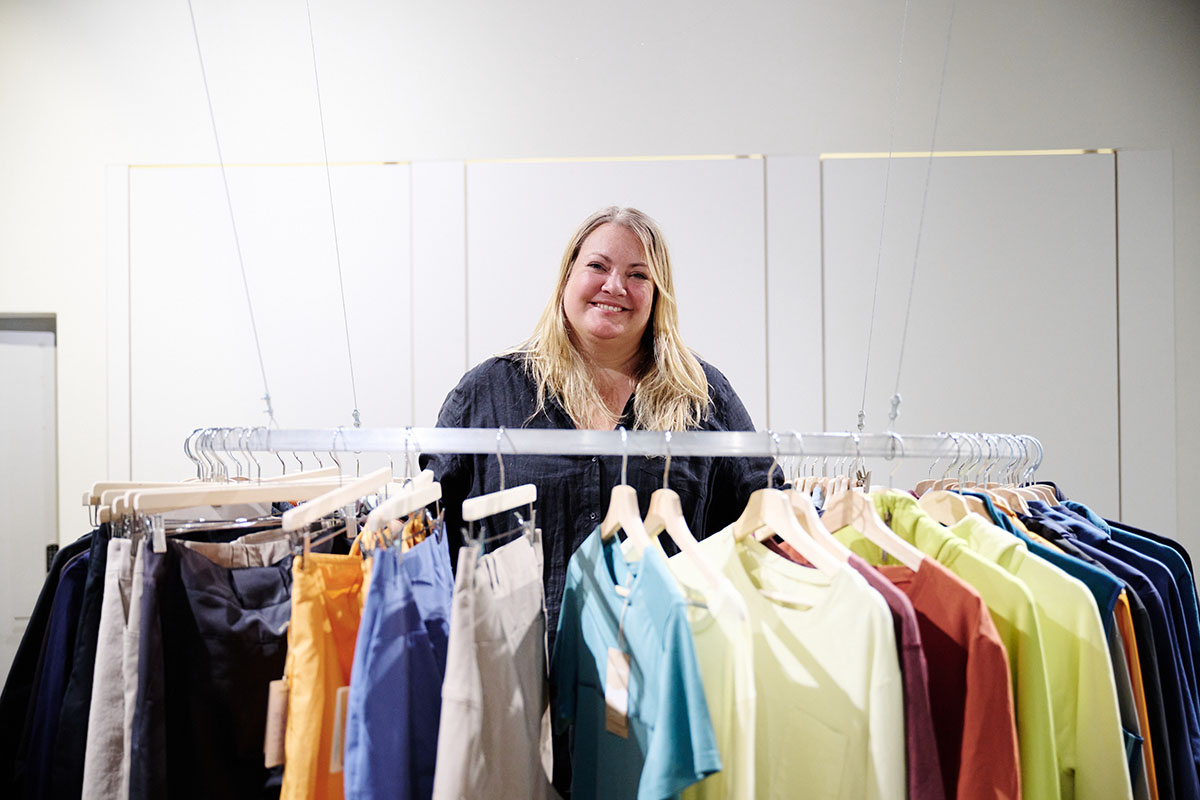
“Our customers really wanted to learn and understand how everything works,” says Angelica Molin, Global Head of DTC at Houdini. Photo: Sport Conrad
What are the lessons learned after the test phase in the Houdini Circle?
Molin sums up: “There was a lot of interest from customers. Our customers really wanted to learn and understand how everything works. However, they were not yet ready for a subscription, and only a few of them signed up. Renting, on the other hand, worked well. It accounted for up to 50 percent of sales in the store, which is huge.”
The concept of renting products instead of owning them has been accepted rather hesitantly beyond shell jackets, Molin admits. The further away a product is worn from one’s own body, the more readily rental is accepted. In contrast, there is less resentment among younger generations. They buy more second-hand anyway. Customers were also interested in finding out how much they could save compared to the new price. Before buying a second-hand product in a certain color, they also wanted to see what alternative colors were available in the range at the new price. These are all valuable insights that will enable the range to be adapted even better to user needs in the future.
Molin draws a positive balance: “We now know that it works. We are now bringing the concept to our three stores in Stockholm, Gothenburg and Åre. Customers who come into our stores will be able to borrow, buy new or second-hand any item they see.”
The task now is to make the services suitable for the mass market via a Reuse catalog especially for retailers and large-scale logistics cooperations. Not an easy task. But after the visit to Stockholm, you want to believe: they can do it. With a clear value proposition, a good dose of curiosity, the necessary stubbornness and staying power.
