
 Login
Login
 Stores
 Cart
Cart
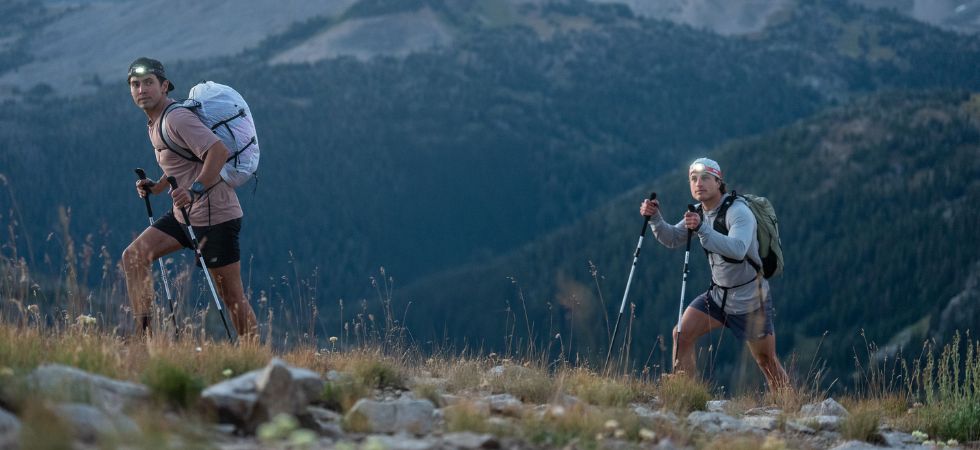
Good hiking poles can make a real difference in the mountains. They help take pressure off your knees on descents, add stability on uneven ground and make it easier to find a steady rhythm on long days out. On steep climbs, slippery trails or multi day hikes with a heavy pack, they are much more than just a handy accessory.
In our hiking poles review, the goal is not to reduce every model to a simple ranking. What matters most is finding the right pole for the way you move in the mountains. Our mountain loving team spends a lot of time outside, from easy hut approaches to demanding alpine hikes, and knows from experience what really counts when it comes to material, construction, pack size, grip comfort and stability.
Because the best hiking poles are not always the lightest or most expensive ones. What really matters is whether they suit your tour, your pace and your expectations. That is why we compare different types of hiking poles and explain what to look for in fixed length poles, telescopic poles and foldable hiking poles.
Key takeaways
- 🥾 Hiking poles help reduce strain on joints and muscles, especially on descents and long hikes with a pack.
- ⛰️ The right construction depends on how you use them: fixed length poles feel especially direct, telescopic poles are highly adjustable and foldable models pack down very small.
- 🎒 Foldable hiking poles are ideal if you need a compact pack size, for example when travelling, trail running or moving through varied terrain.
- ⚖️ Carbon is especially light, while aluminium is particularly robust. Aluminium is a reliable choice for many hikers, while carbon is a great option for fast, sporty tours where every gram counts.
- 📏 The right pole length is key: as a general rule, your elbow should form roughly a 90 degree angle when the pole is placed vertically on the ground.
- 🏔️ Brands such as Leki, Komperdell and Black Diamond have stood for high quality hiking poles with well thought out details for years.
How to choose the right hiking pole
When choosing hiking poles, weight and price should not be the only factors you look at. Out on the mountain, three things matter most: construction, pole length and material. Together, they determine how stable, comfortable and versatile a pole really is.
A lightweight pole can save energy on long tours, but not if stability suffers. A very robust pole gives confidence in rough terrain, but may feel heavier on fast or long days. That is why it is worth taking a closer look at the different designs. The biggest differences are found between fixed length poles, telescopic poles and foldable poles.
Hiking pole construction
The construction determines how compact a hiking pole is, how quickly it is ready to use and how direct the power transfer feels. Depending on the type of tour, a different design may be the better choice.
Fixed length poles
Fixed length hiking poles have a particularly simple design. They consist of one fixed shaft and do not use an adjustment mechanism. This makes them direct, stable and often very light. Sporty mountaineers, trail runners and minimalists in particular appreciate this clean construction.
Advantages:
- Very direct power transfer
- High stability thanks to the simple design
- Fewer moving parts, which means fewer potential weak points
- Ready to use straight away with no adjustment needed
- Ideal for sporty tours with a consistent use case
The downside: the length cannot be adjusted. This makes fixed length poles less flexible if several people want to use the same poles or if you want to change the length depending on the terrain. On steep climbs or long descents, an adjustable length can often feel more comfortable.
Our highlights among fixed length hiking poles are the Leki Smart Flash, Leki Smart Response, Swix NW CT4 and Swix AT2 Pro Tech.


Telescopic poles
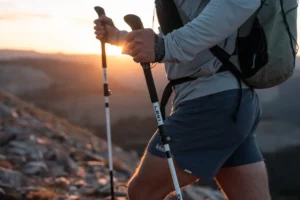
Telescopic poles are the classics among hiking poles. They are made up of several sections that slide into each other and are secured with a locking or twist mechanism. This allows you to adjust the length flexibly and shorten the poles for transport or storage.
For hiking, this construction is especially versatile. You can set the poles a little shorter on the climb and slightly longer on the descent. When traversing across a slope, the length can also be adjusted quickly. That is why telescopic hiking poles perform strongly in many comparisons.
Advantages:
- Flexible length adjustment
- Easy to adapt to different types of terrain
- Practical for climbs, descents and traverses
- Can be used by different people
- More compact than fixed length poles for transport
- Highly versatile for hiking, trekking and mountain tours
Our highlights among telescopic hiking poles are the Komperdell Carbon Pro Zero, Black Diamond Trail, Summit Nepal Carbon and Leki Makalu Lite.


Foldable hiking poles
Foldable hiking poles usually break down into three short sections, making them especially compact to pack away. This is ideal if you often attach your poles to your backpack, carry them in your luggage or only use them for certain sections of a tour. This construction is particularly popular for fast mountain tours, approaches, travel and trail running.
Many modern folding poles are surprisingly stable. Still, it is worth paying close attention to the locking system, grip, section connection and material. If you are looking for a foldable hiking pole, you should not focus on weight alone. Handling, pack size and stability on the trail are just as important.
Advantages:
- Especially small pack size
- Great for backpacks, travel luggage and fast tours
- Quick to assemble and pack away again
- Ideal when the poles are only used for certain sections
- Often very light with a sporty construction
- Practical for trail running, approaches and tours with changing terrain
Our highlights among foldable hiking poles are the Leki Skytera FX Carbon SL, Komperdell FXP Carbon Ultra, Leki Sherpa FX Carbon Strong and Black Diamond Pursuit Carbon FLZ.


Pole length and size
The right pole length is essential for comfort and efficiency. If the pole is too long, your shoulders and arms can be placed under unnecessary strain. If it is too short, you lose support and stability.
ℹ️ A simple rule of thumb: place the pole vertically on the ground and hold the grip. Your elbow should form an angle of roughly 90 degrees.
With telescopic poles, you can adjust the length flexibly. This is especially useful in changing terrain. Uphill, the pole can be slightly shorter. Downhill, it can be slightly longer. When traversing a slope, it can make sense to set the uphill pole shorter and the downhill pole longer.
With fixed length poles, you should choose the size particularly carefully, as it cannot be adjusted later. Depending on the model, foldable poles are available either in fixed lengths or with additional length adjustment. For maximum versatility, foldable poles with adjustable length are a very practical solution.
Material: aluminium vs. carbon
When it comes to material, aluminium and carbon are the two main options. Both have clear strengths and suit different needs.
Aluminium is robust, reliable and can handle tougher use. If the pole hits scree or is put under more pressure in rocky terrain, aluminium is often the more forgiving choice. It is usually a little heavier than carbon, but offers high durability and very good value for money.
Carbon stands out above all for its low weight. Carbon hiking poles feel light and direct, which can be a major advantage on long tours or fast paced outings. At the same time, carbon is more sensitive to sharp impacts and point loads. For very technical tours or rough terrain, it is worth considering whether maximum weight savings or rugged everyday durability matter more to you.
📌 In our hiking pole comparison, both materials show clear strengths. Aluminium scores with robust everyday performance and reliability, especially on classic hikes and mountain tours. Carbon is a great choice for anyone who wants to travel light and values a direct, premium pole feel.
High quality brands for the best hiking poles
Quality is worth it when it comes to hiking poles. Good locking mechanisms, ergonomic grips, durable tips and long lasting straps make a noticeable difference on tour. Established brands in particular bring years of experience from mountaineering, trekking and trail running.
Leki hiking poles in review
Leki is one of the best known brands for hiking and trekking poles. The brand stands for high quality workmanship, well designed grip systems and a wide range of models for different uses. Anyone looking for Leki hiking poles is usually looking for reliable models with strong everyday performance and excellent handling in the mountains.
Leki’s different grip and adjustment systems are especially interesting. Depending on the model, you will find options for comfortable hiking, sporty mountain tours or especially lightweight use.


The best hiking poles from Komperdell
Komperdell is a traditional Austrian brand with deep roots in mountain sports. Its hiking poles are known for solid workmanship and functional details. Many models are designed for hikers who value durability, comfort and reliable stability. For classic mountain tours, hut to hut hikes and trekking, Komperdell offers a strong selection.


Black Diamond hiking poles
Black Diamond comes from the climbing and mountain sports world and brings a high level of technical expertise to its hiking poles. The models are often sporty in character and appeal to anyone who wants to move light, efficiently and with versatile equipment. Many of the brand’s models are an interesting choice for fast tours or alpine approaches.


Conclusion: our hiking poles review
Hiking poles are a small piece of gear with a big effect. They add security, help reduce strain on your joints and make it easier to move efficiently on long tours. Which models are the best hiking poles for you depends above all on your intended use.
Fixed length poles stand out for their low weight and direct power transfer. Telescopic poles are especially versatile and can be adjusted flexibly to different terrain and body sizes. Foldable hiking poles score with a compact pack size and are ideal if you often transport your poles or only use them for certain sections.
Our 2026 hiking poles review shows that there is no single perfect pole for everyone. What matters is the right combination of construction, length, material, grip comfort and stability. Once you know where and how you want to use your poles, finding the right model for your next tour becomes much easier. And of course, you are always welcome to get personal advice in one of our stores.