
 Login
Login
 Stores
 Cart
Cart

The family business Salomon, which initially specialized in winter sports, added the young discipline of trail running to its core areas in 1998. Since the very beginning, the French company has paid attention to combining technical progress with stylish design. In probably no other area is Salomon as famous for this as in the field of running; after all, with its numerous innovations, it has always been one of the world’s most popular running brands.
In the early 2000s, Salomon developed a new shoe model to meet the need for ever faster and lighter footwear. Inspired by local races and by athletes, Salomon shoe designer Reglan Berger had an idea for a shoe that would be light, grippy and stable. It was called the Speedcross and was designed for fast running in the mountains while protecting the feet from rocks, and obstacles and providing stability in the wet underground.
Sixteen years after the release of this shoe, Salomon presents the Speedcross 6, which remains true to the original model as a grippy, lightweight and protective trail shoe.
SPEEDCROSS 1: from Mountain Racing to Trailrunning
Reglan Berger, a designer at Salomon Footwear, watched his colleagues run in the mountains around Annecy and participate in mountain races like the classic Montée de la Tournette, a race that involved climbing 2,000 metres to one of the most famous peaks around Lac d’Annecy. Building on the “Fast & Light” approach for which the brand had become known, Reglan had a vision.
“Pushing the boundaries of mountain racing meant developing a featherweight product that is fast and agile, even on the most difficult, sloping terrain.” – Reglan Berger
The Speedcross, with a low profile and rugged look, began to take shape. The sole with its lug tread provided good grip no matter what the conditions and even on steep terrain. Due to budget constraints, the shoe could only be developed using existing components. The outsole was derived from the XA Harrier with a deep tread. The traditional chassis was replaced by a spring construction that hides the midsole. This construction provided the agility needed to run faster in the mountains, in addition to creating a better rolling motion.
SPEEDCROSS 2: In search of the Salomon Footwear DNA
The Speedcross 2 was developed on the basis of the original, with the aim of retaining the essence of the Speedcross 1 while making it even more accessible and recognizable as a Salomon shoe. The late 2000s was a pivotal time for Salomon as the company gained prominence in the hiking and mountain racing sectors. The team wanted to take adventure sports to the next level, and the Speedcross was the obvious choice to do so. The designers were also looking for the Salomon DNA: what do all Salomon shoes have in common, and how can they represent that in the products? The answer was found in technology: the SensiFit, which encloses the foot from the midsole to the lacing system and thus provides a secure, close-to-the-foot and downright individual fit all over the foot.
The result was a high-performance, robust, aggressive shoe that was easily recognizable as a Salomon shoe thanks to its unique design elements. Although the shoe was still well received, some athletes noticed a lack of stability under the heel as the chassis had been removed. This was to be fixed in the next generation and eventually lead to the commercial success of the Speedcross.
SPEEDCROSS 3: STABILITY AND SUCCESS WITH THE BROAD TARGET GROUP
The next generation Speedcross arrived in 2011. Warren Bosomworth delivered the first prototype of the Speedcross 3 in 2010, and positive feedback from Salomon’s fell running and trail running athletes led to a proper brief for a third Speedcross. The new generation had a revised, wider heel for more stability, a seamless welded upper, a more cushioned EVA midsole and deeper lugs on the outsole that deform on impact. The aesthetics of the shoe have remained unchanged, with the SensiFit construction and PowerBand still highly visible on the Speedcross 3.
The Speedcross 3, like its predecessors, was a performance shoe and Salomon’s trail runners were very fond of it. After trying his first Speedcross in 2007, Scottish mountain runner Tom Owens ran all his trail races with the Speedcross 2 and 3 from 2008 to 2011, winning the Transalpine Run in 2009 and 2010, the Syraid World Championships in Italy in 2010 and the Sentiero delle Gringe Skyrace Final in 2011.
The Speedcross 3 solved the stability problems of previous versions and confirmed that this unique design has amazing potential, not only in the world of trail running. By 2015, Salomon had sold more than 20 million pairs of Speedcross.

SPEEDCROSS 4: THE Visual UPDATE
Christophe Borlet, another Salomon designer who worked on the evolution of this shoe, was afraid to change too much the icon that the Speedcross 3 had become. Still, there were some aspects that needed tweaking, including the shoe entry area, which wore out quite quickly.
With the Speedcross 4, an attempt was made to make the shoe lower and change the lugs for better accessibility. The Speedcross 4 was commercially successful and sold better than its popular predecessor, but this update took away what made the Speedcross successful: its aggressive silhouette with chunky lugs.
Feedback from Parisian shop The Broken Arm and German designer Boris Bidjan Saberi, who had both worked with Salomon on footwear, was that this Speedcross 4 took away the uniqueness of the previous versions and tried to put it in trail running shape. Although it was still successful, the designers wanted to return to the origin of the Speedcross.
SPEEDCROSS 5: RESHAPING A LEGEND
To create the Speedcross 5, Salomon designer Baptiste Tarenne wanted to recapture the shoe’s original DNA to stay true to what made it iconic. He wanted to give it back its athletic silhouette and aggressive lug profile. The challenge was to develop the shoe in a new and modern way.
The Speedcross 5 has a higher profile, more lugs on the outsole, more comfort as well as a better fit on the foot and returns to everything that has made the Speedcross iconic over the years. It’s designed to offer more comfort and more grip, with larger treads and a bigger bottom plate.
The shoe has also been a hit with urban consumers and even designers from the fashion world. The colours of the Speedcross 5 were not only designed for a sporty audience. In short, the shoe should also be wearable beyond the world of trail running.
Speedcross 6: THE SHOE THAT BROUGHT SPEED TO THE TRAILS
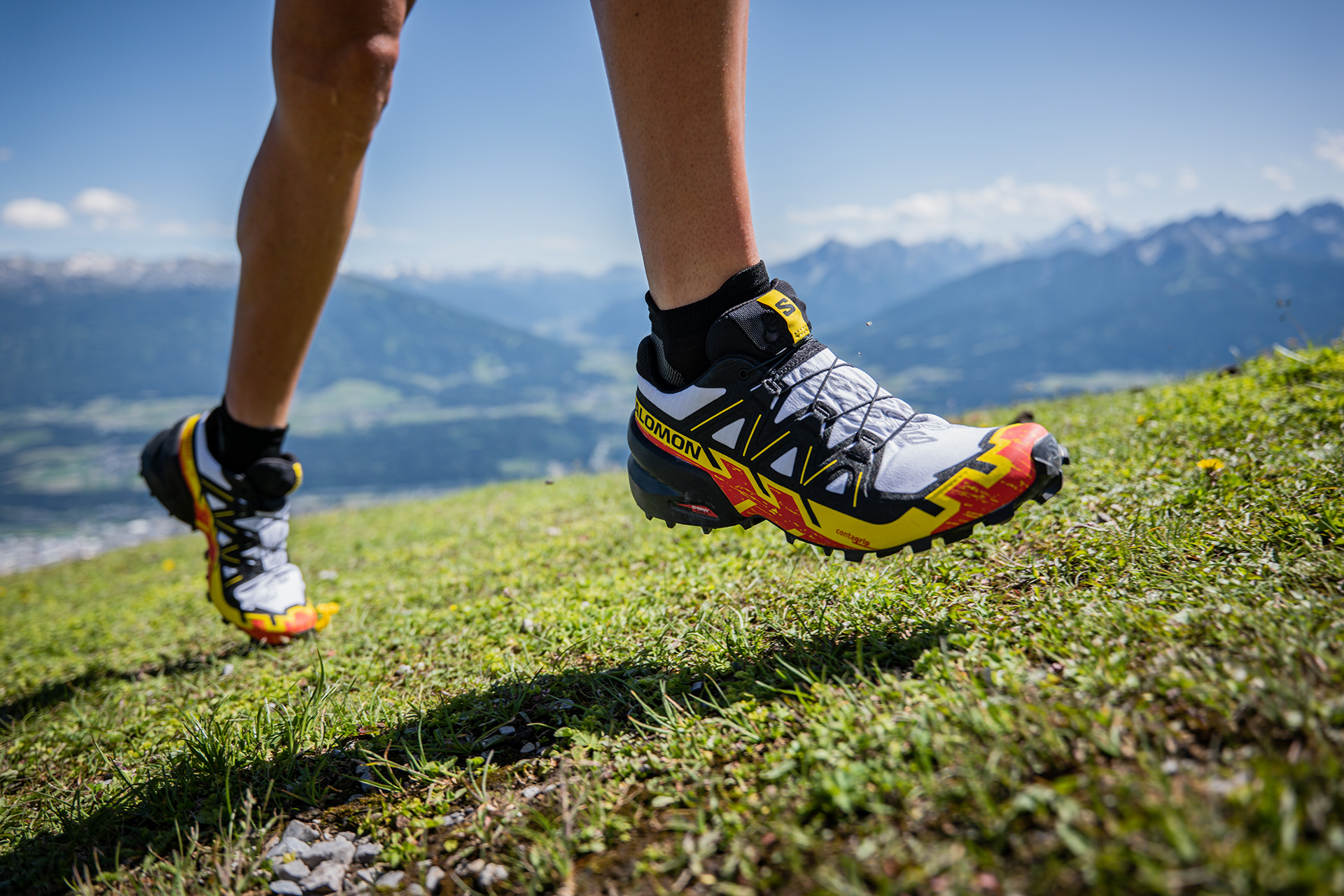
The Speedcross 6, which has been available since July 2022, stays true to the roots of the Speedcross family but has less weight (298 g) and a stronger, grippier connection to the ground in wet conditions. An updated outsole with Y-shaped lugs that wick away mud faster provides an improved grip. The shoe also offers classic Speedcross comfort thanks to a revised, foot-hugging upper that is both functional and fashionable. The Sensifit construction provides precise support and the EnergyCell+ midsole offers to cushion underfoot.
The design of the shoe recalls the tyre-like look that inspired Reglan Berger when he designed the very first Speedcross. Guillaume Salmon, who designed the new Speedcross 6, wanted to keep the modern look of the Speedcross 5, so the shoe’s design works just as well in black as it does in more striking colours.


SPEEDCROSS: FROM THE TRAILS TO THE ROAD
Over the years, the Speedcross unique look has caught on with more than just designers and trail runners. When fashion retailer The Broken Arm contacted Salomon in 2015 to sell the Snowcross shoe – an offshoot of the Speedcross designed for running in the snow with a high gaiter and a completely waterproof construction – it became clear that the Speedcross had great potential for the city.
The iconic silhouette of the Speedcross 3 has since been reworked several times with new colour palettes and gradients. This original, unique look allows designers to play with each element, adding details and customizing the shoe to give it a different appeal.
The Speedcross 4 has also been reworked in collaboration with Palace, a skateboarding brand from London.
Although the purpose of the shoe has changed over time, the Speedcross remains an icon, and the new Speedcross 6 is true to the DNA of its predecessors: fast running in the mountains.