
 Login
Login Stores
 Cart
Cart

Ski touring clothing
Our touring outfit tips
Ski touring requires clothing that is robust and can be quickly adapted to local conditions. After all, ski touring exposes you to a wide range of conditions, from snowstorms in the dead of winter to spring heat and sunshine. Ski touring clothing uses functional materials and ventilation zones to regulate body temperature.
The onion principle has also proved its worth. Wearing several layers of clothing helps you adapt to the weather. A layer can be taken off or put on as needed. It is also important to have a change of shirt for the summit break and an insulating jacket for emergencies. We'll explain in detail what else you need to take with you.


The optimal touring ski outfit consists of:
· Base layer + possibly sports bra
· Ski touring socks
· Midlayer
· Touring pants
· Touring jacket
· Touring gloves
· Headwear + sunglasses
· Change of shirt for the summit break & descent
· If necessary or for very cold days: insulation pants or skirt
Baselayer
The most important function of a ski touring base layer is moisture transport. There is nothing worse than being sweaty and cold on the mountain. That's why you should use functional materials for your first layer of clothing.
Ski underwear can be made from synthetic fibres, merino wool or a blend of synthetic fibres and merino wool. The latter tries to combine the best of both fibres and is slightly more robust than pure wool.
However, ski tourers should avoid cotton. It doesn't dry well in winter and you'll cool down quickly. It makes sense to have a second base layer shirt in your backpack. This means you can wear a dry first layer on the summit or in the hut. Even functional shirts made from synthetic fibres sometimes reach their limits during strenuous activities.
Ski touring socks
Ski socks for touring are usually quite thin and should fit well to avoid blisters. It is important that they wick moisture away from the skin. Compression stockings are another option.
Midlayer
Midlayers come in many forms. Whether it's a long-sleeved shirt with a stand-up collar or a hooded sweatshirt, the function of the second layer is to trap heat. When it comes to materials, ski mountaineers can choose between synthetic fibres and wool. Depending on whether you tend to freeze or sweat, there are thinner or thicker mid layers.
Outer layer: hardshell jacket and pants
The outer layer protects against wind and moisture. Hard shell jackets and trousers are ideal for ski touring. Ski touring is very demanding. Lined jackets and pants make it harder for ski tourers to adapt to the temperature.
Hardshells are available with a variety of membranes. For ski touring, hardshell jackets and pants offer a balance of weather protection, durability, breathability and reduced weight. Depending on what is more important to you, manufacturers and products will have different priorities. Also look out for ventilation zips. If you like to be out in the powder, jackets and trousers with powderskits and gaiters are a good choice – some manufacturers allow you to combine the powderskirt of the jacket with the pants.
When the weather is nice and spring is approaching, softshell jackets and trousers are an option. They are much more breathable than hardshells, but offer less protection when wet.
Insulation
Down or synthetic fibre jackets or vests can provide additional warmth. An insulating jacket is important in an emergency, and its light weight and small pack size make it easy to store in a ski touring rucksack. Down or synthetic insulation like Primaloft® is a matter of taste - although synthetic fibre insulation cannot match the thermal performance of high quality down. However, down stops providing warmth when it gets wet. Synthetic fibres still retain heat when wet.
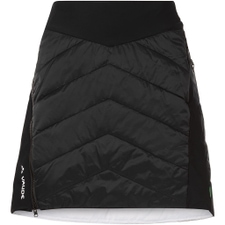
Additional tip: Special insulating skirts or trousers are an option on very cold winter days. Thanks to their zip fasteners, they can be quickly and easily put on over your ski touring pants and provide plenty of warmth.
Ski touring gloves
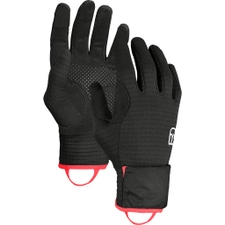
Special skitouring gloves are recommended for climbing. They are thinner than classic ski gloves and therefore offer a better grip on the poles. Ski touring gloves often only have a windproof membrane. That's why, in early and mid-winter, you should have an extra pair of ski gloves in your backpack and use them for the descent. They will keep you warm and protect you from moisture.
Conclusion
If you do a lot of backcountry ski touring, you may even want to consider buying different combinations of mid- and outer layers. This means, for example, that for spring ski touring you should use soft shell trousers and jackets, which are thinner and less warm. In mid-winter, on the other hand, ski mountaineers will benefit more from completely waterproof and windproof hardshell garments with membranes such as GORE-TEX® or Sympatex®. Ski touring clothing is complemented by the right equipment. Use our packing list to make sure you don't forget anything!



Ski touring packing list: what do I need to take?
Whether you are an ambitious skier or a freeride enthusiast, you will benefit from taking only what you really need. Extra luggage is a waste of energy. However, many things are essential for safety reasons.
One of the absolute must-haves is the standard avalanche equipment, consisting of a shovel, probe and avalanche transceiver. A first aid kit should also be carried at all times, and on many trips a bivouac bag is highly recommended for emergencies. An airbag backpack has become the standard for many off-piste trips, as manufacturers work to minimise the weight of the rucksack.
A charged mobile phone is also essential so that you can make an emergency call in case of an accident. But that only works if you know where you are. That's why you should know how to locate your position on a GPS or map. Apps like SOS-EU-Alp are also useful, as they automatically provide your location when you make an emergency call. Download the app for your iPhone here. Andoird users can find the app here.
Indispensable even when the weather promises sunshine and mild temperatures: an insulating jacket for breaks, bad weather or emergencies. In the mountains, the situation can quickly become serious. Insulated trousers or a padded skirt are also recommended for people who feel cold easily.
To find out what else you should take with you, check out our detailed ski touring packinglist on our blog.